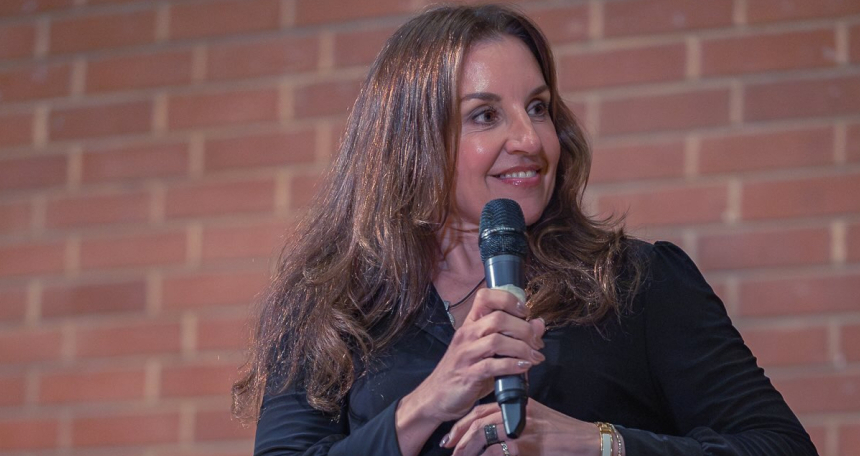
Sarah Willingham is a serial entrepreneur, investor and former Dragon on BBC's Dragons' Den. She built her career at Pizza Express opening restaurants internationally, then went on to grow and exit the Bombay Bicycle Club chain of Indian restaurants. Today she invests in and operates multiple consumer-facing businesses, most notably Nightcap plc.
This interview was conducted by Terry Blackburn, Founder of The Wealthy Advisers Club, the largest online training community of its type now with 2,100 members.
Terry Blackburn (TB): Tell us a bit about how it all began for you.
Sarah Willingham (SW): I wasn't brought up around entrepreneurs or people who had their own business. My dad worked for Wedgwood in Stoke and my mum was a maths teacher. But I was always really curious about business. I didn't realise that was the thing I was curious about, but I was always fascinated by how we gravitated towards the same brands, bought the same stuff and wore the same trainers.
I also really wanted to travel, and my dad wouldn't let me have a gap year because he said, "If you go and have a gap year, you'll never come back," which might have been true. I studied business at university and found the thing I was really interested in. I loved consumer-facing stuff. I loved talking to the customer, understanding the customer, and learning how to talk to the customer to get them to buy from you or use you ultimately.
But in my twenties, I wanted to travel and I found my thing in hospitality. I was at Pizza Express and opened restaurants all over the world in their international department. I had no intention at this point of going on my own, because I was learning and I loved what I was doing. Every single day was a school day.
Then as I got towards the end of my twenties, I'd realised that international development wasn't sustainable. I couldn't continue to live out of a suitcase if I was going to have a family. And I really, really wanted to be a mum. It was really important to me, so I realised I couldn't stay on the path I was on. I was going to have to move and do something different.
So I went to the board of Pizza Express and I said, "Look, I can't continue to do this and it's not really core business for you, so I'm going to leave and do something different." And they said, "Why don't you stay and work for us doing what we call special projects?" My dad always said they're the first people to get made redundant and he's probably right. But if the business is going well, you're actually in for a really good ride, because you do loads of really fun stuff.
During that year, I shared an office with the CEO and the managing director of Pizza Express. This was at the time when Pizza Express were opening 40 restaurants a year. It was a floated business, doing really, really well. They had a simple, replicable business model that everybody wanted to copy. I really held them up on a pedestal and thought, these are the smartest people in the world.
I shared an office with them for a year and during the course of that year, I just asked all the questions I could. By the end of that year, I realised that I really understood what they did. I really got it and that was when I thought to myself, if I want to have a family, I've got to control my own diary. I need to make a bit of cash, because that would help me gain my freedom.
By the end of that year, I thought, I understand what you do. I understand why they used equity when they used it, why they used debt, how they expanded, what their return on investment model was. And I thought, right, I'm going to go and do it myself.
TB: And how old were you at that point?
SW: 28 and yes, I no longer have the 30 Under 30 title, but I did have it once. That was my deciding moment, where something clicked in my head and I realised it was nowhere near as complicated as I thought it was. I could just give this a go and do it myself.
So I looked around the market and thought, what is it that we all love, but there's no real chain, no real group? And that was Indian food. I said, right, that's it. I'm going to have the largest chain of Indian restaurants in the UK. And that's what I went on and did by creating the Bombay Bicycle Club .
That was the big, big moment. What had happened during that period was that I'd really simplified it in my head. Instead of it all seeming so complex and so complicated, I'd broken it down and gone, actually, it's not that hard. With a fair wind and surrounded by great people, just keep asking questions, you've got this. That was when I made the move to do it on my own.
TB: Having curiosity from being so young obviously helped you, because you were so curious to learn from the people there. It's like having a mentor as it's learning from others. Nobody's really self-made, are they?
SW: No question was ever a stupid question, because I was just Sarah from Stoke at the time. You can just ask as many questions as you want and everybody just answers them. By the end of it, you're like, oh yeah, actually nobody's that smart. We're all as smart as each other. We can work it out, as long as you're open and ask the right questions of the right people.
I constantly say to my team, "You don't need to know the answer. You just need to know that there is a question that needs asking, and you need to know who to phone." Life is about knowing who your phone-a-friend is at any given time, knowing that this is a moment where actually I don't know the answer.
I now use AI for that a lot. Often it's a sense check. But I also still have a guy in my phone who's saved as Yoda, who is brilliant. He always answers the question. It's about knowing that there is a question in the first place, being curious enough to realise this is a moment where I might get this wrong, I should sense check it.
TB: So you’re 28, you’ve set up your first business and all of a sudden Dragons' Den. What does that journey look like?
SW: The business did really well and I grew it. I met my husband and started to have my children, and I had four kids in four years. That was definitely a ‘be careful what you wish for moment’, where I had 1,500 staff and was just about to have my third.
TB: So you were still running the companies during this time?
SW: Still running all the companies. But you see, when you've got one baby, they're really portable. You just put them in a papoose and off you go. The challenge came when I then had another one, and although I could take my second everywhere with me, my first was now a toddler and she was no longer portable.
I ended up selling the Bombay Bicycle Club before I had number three. I just had two at the time when I sold, and then realised that again, to be in control of my own diary, I didn't want to go back. I was unemployable by that point. So I started investing, and that worked really, really well.
I'd made some money from the Bombay Bicycle Club and I started doing lots of different investments in different sectors, where I was quite an active investor. So I could actually work with entrepreneurs, but nobody else was reliant on me getting up in the morning, other than my own family. That really moved the needle for me. It made a real difference in my own work-life balance, if you want to call it that. Just getting it right for me.
TB: How did Dragon’s Den come about?
SW: I met my husband and started to have children and I had four kids in four years. So I ended up selling the Bombay Bicycle Club just before I had number three, and then realised that I needed to be in control of my diary, so I started investing and that worked really well. I'd made some money from the Bombay Bicycle Club and I started doing lots of different investments in different sectors. I was quite an active investor, so I could actually work with entrepreneurs but nobody else was reliant on me getting up in the morning other than my own family, and that really moved the needle for me, made a real difference in my own work life balance.
I'd set up a business that didn't do particularly well, which was an online kind of money-saving expert. It didn't fail, but I didn't make hundreds of millions out of it. And off the back of that I was doing quite a lot of TV. My husband, Michael and I used to do this thing every year, as I'm obsessed with time and how I spend it. It's the one thing I know I'm not gonna get back and it's the one thing I hold most precious, so Michael and I used to do this thing at the beginning of every year. We used to we do this pie chart of time and the reason we do a pie chart is because when you look at something as a pie chart you realise the relativity of time.
Ultimately something has to give, because you can't do everything. So I asked what am I doing all this media for? I don't even particularly enjoy it. So I decided I was going to give up all the TV, as that was a big chunk of this pie chart.
I had just handed my notice in for all the media and that afternoon, I received an email asking me to screen test for Dragon's Den. For us, that's the one show we love, because we were very active investors at the time and doing quite a lot. Anyway, I thought, well I'll never get it, but what a laugh I'll go along and I’ll get to meet Deborah Meaden and maybe we’ll become best friends!
So went along to the screen test and they’d actually had a dropout and they were screen-testing loads more women, so it all happened really really quickly.
TB: Who’s your favourite Dragon?
SW: I couldn’t possibly say that! I'm actually still really close with Nick and Deborah.
Nick is a really great guy, really clever, not interested in any of the media side of it at all. Just a really smart, just really good human. He's just a really, really good guy and his moonpig business was brilliant. He did his NBA at the same place I did mine, which was at Cranfield, and when he was there, he sat and wrote three business plans, all completely different and in the end he decided that I'm going to do that one and it was Moonpig.
TB: What’s your advice to other entrepreneurs?
SW: Every single time I do something and I'm driven to learn, to progress and to see something grow. Every single morning, I get up to make myself redundant, of course you go through periods where actually you've got to work harder and harder on the business to be able to make yourself redundant. It's like when you delegate something to somebody else for the first time and you've started your own business, it's painful to begin with because they're not as good as you are and don’t have your superpowers, the things that you're exceptional at. It takes time, but in the end, when they get there, that just frees up this entire chunk of time for you to be able to focus and do something else, that's my drive.
TB: What are the fundamentals for business for you? What is non-negotiable?
SW: If you’re an investor, what makes this a really investable business, what is the need for it? Who are you selling it to? You get people who come into the Den and they go, everybody in the world wants this. At that stage I'm out, because you're never going to be able to talk to eight billion people.
The second bit is, how am I going to talk to that customer? Can I see a way of reaching that customer, have you got a marketing model, which is an effective return on investment? How much is every lead worth to you? How much is every sale worth to you? How do I get them to buy?
The third bit for me is always about the individual and that comes back to that resilience bit. So often the business model that we start out with at the beginning of a business is not the business model that we end with, but is that person open to trying a different business model? Because it could be very different to the one you think it's gonna be, but trying to find it and being open to that opportunity, open to learning, open to trying things and open to failing as well, it's also really, really important.
TB: Any predictions from an AI perspective, industries, niches, things that are going to happen. How positive and negative about AI?
SW: I do think it's going to have an enormous impact on employment in a lot of industries. The really big tech industries over in the USA in particular, you can see thousands of people being affected. However, it obviously doesn't touch much on the consumer-facing side like my industry and leisure. Let's face it, AI's not going to suddenly pour a pint or make a burger.
I was in a pitch recently and somebody said, the great thing about your industry is that it's AI resilient and it’s amazing how investment turns and people will now say we’ll look at your industry now because it's not going to be impacted.
