Research shows AI tool misidentified Japanese knotweed in 7% of cases, putting homeowners, buyers and sellers at risk as growing season approaches
Homeowners and property buyers are being warned not to rely on Artificial Intelligence tools to identify Japanese knotweed, as new analysis reveals that a popular AI tool failed to correctly identify the invasive plant in 7% of cases. For homeowners, buyers and sellers, 100% accuracy is essential to avoid legal and financial consequences.
In a test carried out by Environet, 100 images of Japanese knotweed taken at different times of year and in varying conditions were uploaded to ChatGPT. While the plant was correctly identified in 93 cases, in seven instances it was mistaken for other species including cherry laurel, spiraea, rose, dock, Virginia creeper and peony.
The findings raise concerns for homeowners and property sellers, who have a legal obligation to declare the presence of Japanese knotweed when selling a property. All sellers are required to answer a direct question about Japanese knotweed on the Law Society’s TA6 form, and failure to correctly identify the plant and declare its presence can lead to aborted sales or legal action from buyers post-completion.
The appearance of Japanese knotweed can vary significantly throughout the year – particularly if it has been cut back or treated with herbicide in the past. While AI can be helpful as a general guide, relying solely on automated tools carries significant risk in the context of property transactions, where accuracy is critical.
The warning comes as Japanese knotweed approaches its spring growing season, with early shoots expected to emerge in warmer parts of the UK and sheltered urban areas from late February or early March.
Emily Grant, Director of Environet, said: “AI tools can be a useful starting point, but they are far from 100% reliable when it comes to identifying invasive plants like Japanese knotweed. Our analysis showed AI is competent at recognising knotweed when it presents typically, but it becomes confused when it presents atypically, which is common after it’s been chemically treated or repeatedly cut back.
“It’s always best to have a plant checked by a qualified specialist who can confirm what it is and advise on the appropriate next steps. Early and accurate identification is critical to keeping treatment costs down and avoiding legal complications further down the line.”
Environet provides a free plant ID service to members of the public wishing to identify a plant they are concerned about. Photos can be uploaded to the company’s website for expert assessment by trained specialists, at no cost.
Analysis of photos submitted during 2025 shows that Japanese knotweed was correctly identified by the public in just 24% of cases, underlining how difficult the plant can be to recognise. Bindweed was the species most commonly mistaken for knotweed, accounting for 23% of submissions last year. While bindweed shares several visual similarities, including heart-shaped leaves and white flowers, it is relatively harmless and does not cause structural damage.
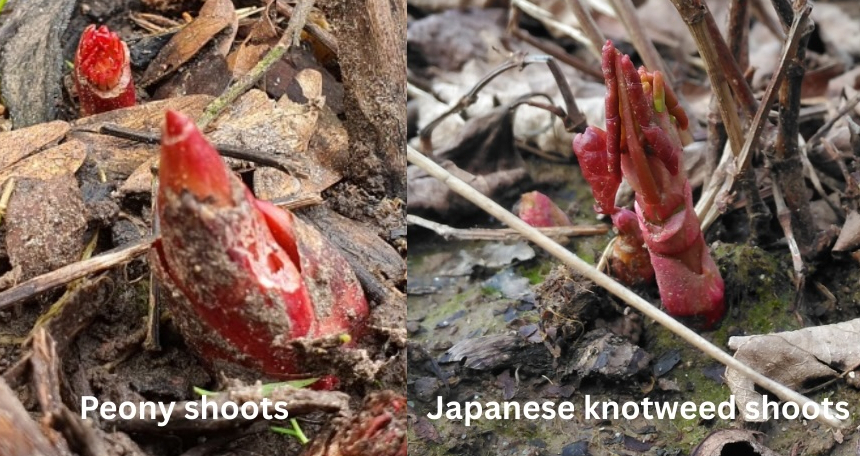
Other plants frequently misidentified as Japanese knotweed include dogwood, ivy, Himalayan balsam, bramble, lilac and dock. In early spring, Environet also typically sees a surge in photo submissions of peony shoots, the red, asparagus-like stems of which can closely resemble knotweed when they first emerge from the ground.
Failure to correctly identify and treat Japanese knotweed early allows it to spread rapidly and become firmly established, growing at up to 10cm per day by early summer. Left untreated, it can push through paths, patios and driveways, and over time may damage homes and outbuildings. Knotweed can also spread underground and encroach onto neighbouring properties, leading to legal disputes.
